Business / Insights
Nordic businessculture
Practical expectations rather than national character. How meetings, decisions and relationships tend to work across the Nordic region — with the caveat that organisations differ more than countries.
14 September 2026 · 3 min read
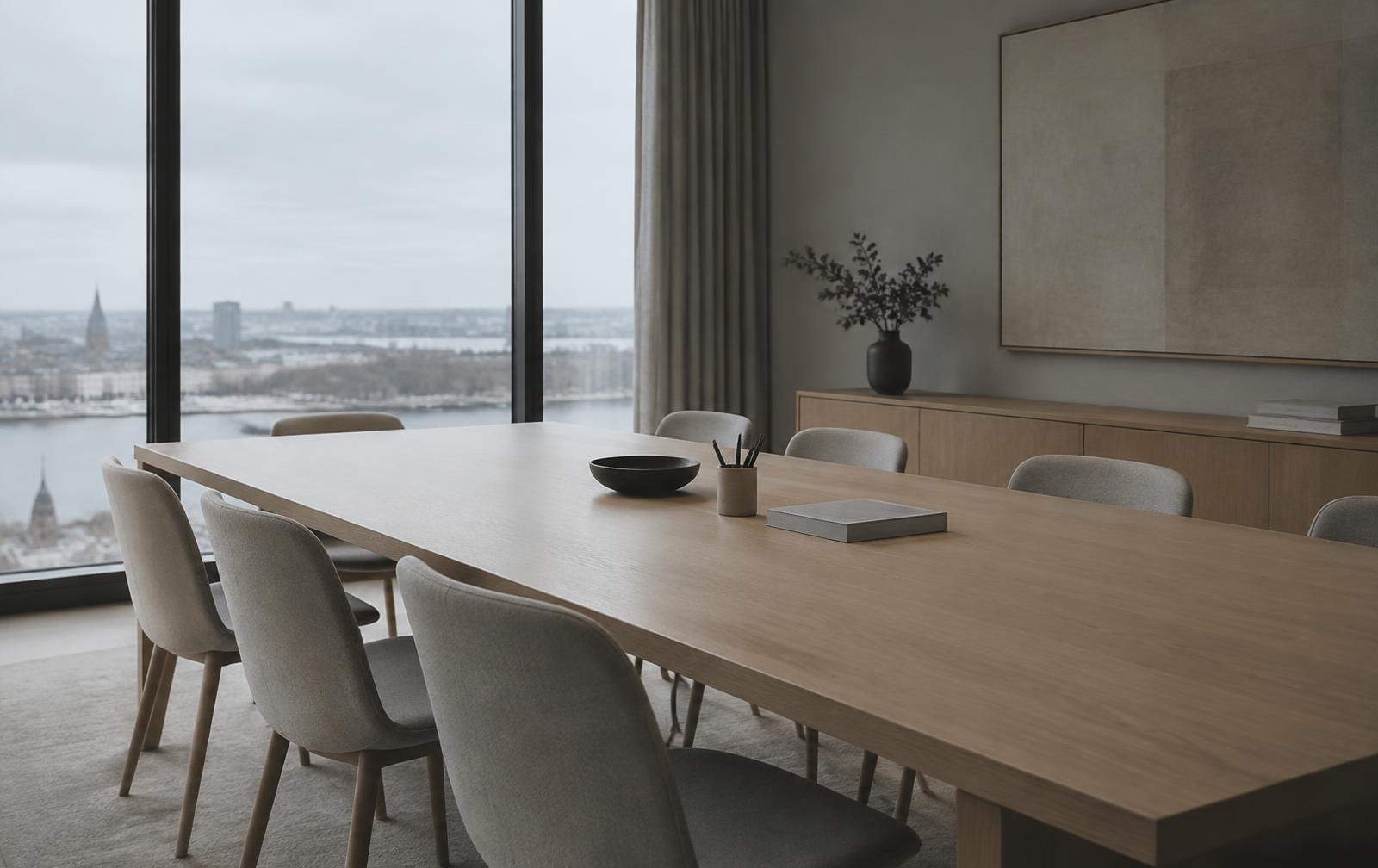
Business culture is the least reliable subject to generalise about, and the most frequently generalised. What follows is not a description of national character. It is a set of practical expectations that international companies encounter often enough in the Nordics to be worth preparing for — and which vary considerably between a family-owned manufacturer, a listed group and a young technology company in the same city.
Trust is assumed, then tested
Commercial relationships here often begin with a level of trust that surprises visitors: information is shared early, agreements can be brief, and formality is light. That trust is not naivety. It is efficient, and it is contingent. What is promised is expected to happen, and a missed commitment carries more weight than an equivalent slip would in many markets.
Communication is direct, not blunt
Disagreement is usually stated plainly and without much cushioning, which can read as coolness. It is rarely personal. Equally, enthusiasm is expressed with restraint: a positive reception may sound measured. Reading interest requires attention to what is being asked rather than to how warmly it is said.
Organisations are flatter than the chart suggests
Titles carry less weight than in most markets. Junior colleagues speak in meetings, contradict senior colleagues, and are expected to. For a visiting supplier this has a practical consequence: the person who understands the technical detail may matter more to the outcome than the person who signs. Addressing only the most senior participant tends to slow things down.
Preparation and punctuality
Meetings start on time, follow the agenda that was circulated, and end when the agenda ends. Participants will have read the material. Arriving to improvise a pitch is not received as flexibility; it is received as a lack of seriousness. Time is treated as a shared resource.
Decisions take longer to make here, and less time to unmake later.
Consensus and the shape of a decision
Many Nordic organisations decide by building agreement rather than by instruction. This makes the process slower and the outcome more stable: once a decision is taken, it is generally implemented without relitigation. Foreign suppliers frequently misread the pause before a decision as disinterest, and press — which rarely accelerates anything. The more useful response is to supply what the internal discussion needs.
Transparency and documentation
Expect questions about ownership, supply chain, certification and compliance to be asked plainly and answered plainly. Confidentiality is respected, but evasiveness is costly. In procurement contexts, sustainability and working-condition requirements are increasingly formal parts of the evaluation rather than statements of preference — and claims are checked.
Sustainability as a commercial requirement
Environmental expectations vary by sector, but the pattern is consistent: they belong to procurement, not to marketing. Suppliers who can document what they claim are treated as credible. Suppliers whose claims outrun their evidence lose ground quickly, and the reputational effect travels between the five markets.
Long-term relationships
Partner turnover tends to be low. Buyers, distributors and industrial customers often keep relationships for years, and evaluate a new supplier against that horizon: reliability over several quarters matters more than an attractive opening offer. This is slower to enter and considerably more durable once entered.
A necessary caveat
The five countries are not interchangeable, and neither are the organisations within them. Danish directness differs in texture from Finnish economy of speech; a Reykjavík importer and a Gothenburg industrial group operate at different speeds for structural reasons. Treat the observations above as a starting posture, and let each counterpart correct it.